Why 'Useful' Models Matter More Than 'Perfect' Ones
Understanding how aircraft behave in flight is one of the most challenging aspects of aerospace engineering education. While equations describe the physics of flight, they rarely convey how aerodynamic forces, mass properties, and control inputs interact dynamically. Engineering flight simulation provides a powerful way to bridge this gap between theory and experience.
“All models are wrong, but some are useful.”
— George E. P. Box
No simulation perfectly reproduces reality, and no mathematical model captures every variable of a complex physical system. Yet models remain essential because they allow engineers and students to explore behaviour, understand relationships, and make informed decisions.
In aerospace education, the goal is therefore not perfect replication, but perceptible realism: models that reproduce the key aerodynamic and dynamic characteristics needed to understand aircraft behaviour.
Research using the Merlin engineering flight simulator shows that such perceptibly realistic models can be achieved through systematic modelling and validation approaches, including pilot evaluation of handling qualities (Moidel, 2021).
Simulation as a Bridge Between Theory and Experience
Students spend years studying the theoretical foundations of flight:
- Lift and drag
- Aircraft performance
- Stability and control
- Dynamic flight modes
However, equations alone rarely show how these elements interact within a complete aircraft system.
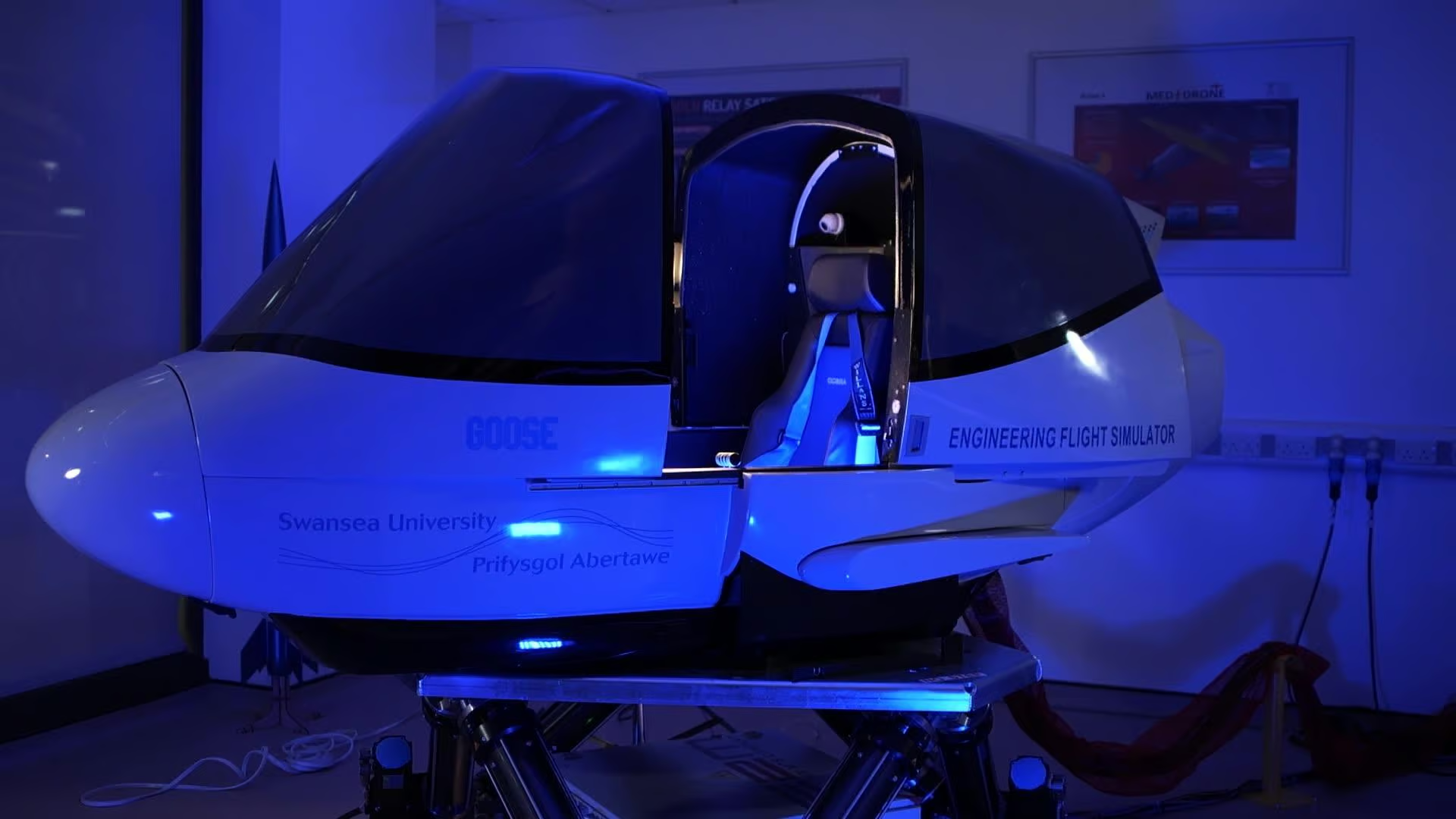
Merlin engineering flight simulators allow students to observe these interactions directly. Changes to parameters such as centre of gravity location, aerodynamic characteristics, or control inputs immediately translate into visible aircraft responses.
This transition, from calculation to consequence, is where engineering intuition begins to develop.
Studies integrating the Merlin flight simulator into aerospace courses show that simulation significantly improves students’ understanding of aircraft stability, control, and flight dynamics (Memon et al., 2017).
Three Levels of Learning Through Flight Simulation
Engineering flight simulators support learning at three complementary levels.
- Experiencing aircraft behaviour
Students observe how aircraft respond to control inputs, disturbances, and changes in flight condition.
- Analysing flight dynamics
Dynamic modes such as phugoid motion, short-period oscillations, and Dutch roll can be excited and studied directly in simulation.
- Exploring aircraft design
Students can build aircraft models from geometric and aerodynamic parameters and evaluate their performance and handling qualities.
Together, these activities connect theoretical knowledge with practical engineering insight.
Engineering Flight Simulation vs Pilot Training Simulation
Unlike traditional flight simulators designed for pilot training, Merlin is an engineering flight simulator.
Its purpose is to support the teaching and investigation of:
- Flight mechanics
- Flight dynamics
- Aircraft design
- Handling qualities
Students and researchers can construct aircraft models by defining parameters such as geometry, aerodynamic surfaces, propulsion systems, and mass properties. These models can then be flown and evaluated within the simulator.
This creates a powerful design–test–refine cycle, mirroring real-world engineering practice (Done & Neal, 2011).
Simplicity Without Losing Meaning
“Everything should be made as simple as possible, but not simpler.”
— Albert Einstein
Engineering models must balance simplicity and fidelity. Oversimplified models hide important physical behaviour, while overly complex models can obscure the relationships engineers need to understand.
Merlin intentionally occupies a middle ground: it preserves the essential physics of aircraft performance, stability, and control while remaining accessible enough to support experimentation and learning.
Developing Engineering Intuition
Aircraft behaviour emerges from the interaction of many factors:
- Aerodynamic forces
- Mass distribution
- Control inputs
- Propulsion systems
Simulation allows students and engineers to experiment with these variables, observe the results, and refine their understanding.
This exploratory process encourages:
- Active learning
- Critical thinking
- Systems-level understanding
Educational studies confirm that hands-on simulation significantly strengthens conceptual understanding in aerospace engineering courses (Memon et al., 2017).
Conclusion
Flight simulation is not about perfectly reproducing reality.
It is about creating models that are useful for understanding reality.
When simulation models are grounded in aerodynamic theory, verified through experimentation, and used within an exploratory environment, they become powerful tools for both education and engineering insight.
Engineering flight simulators such as Merlin enable students and engineers to move beyond equations and diagrams, allowing them to observe, test, and refine their understanding of aircraft behaviour.
If Merlin Flight Simulation could be the right fit for your programme, we would be glad to hear from you.