Modern military forces seek to balance demands that are seemingly at odds: enabling the training and improvement of skills without sharply increasing the costs in both money and time.
This is what has led to military simulation training becoming a fully realised, versatile solution for instilling combat readiness in trainees, be they field engineers, tank drivers, or a boots-on-the-ground soldier.
Why do modern armed forces use simulation to improve war-fighting capability?
Forces including the UK military and NATO are looking for tactical training systems that combine managed costs with lower logistical demands, while still delivering training that meets exceptional standards.
Military simulation offers a degree of flexibility that allows training programmes to be used frequently and repeatedly, with as many variations in exercises as there are roles in any military force.
This is especially useful for pilots and vehicle drivers who, if they can't be in their respective machinery, need to operate something that mimics the experience as closely as possible.
Furthermore, if the goal is to practice operating the controls and mastering movement, simulators allow this to be drilled without risk of collisions or causing damage, getting lost, or consuming fuel.
When one run-through is finished, the programme can be reset and another cued up in a matter of seconds.
What does modern defence simulation training involve?
- Preparation of soldiers for combat scenarios
Arguably the core reason for combat training simulators, a training solution is doing little else if its users aren't preparing for real-world engagements. Simulators create immersive experiences that allow trainees to put their theory into practice, whether that's manoeuvres, communications, or taking off in a helicopter.
- Recreates realistic battlefield environments to encourage decision-making practice
A fair critique of simulators is that they can't fully prepare soldiers for every facet of a combat scenario, such as fatigue. However, they can teach mental and emotional readiness, both crucial for thinking clearly and acting rationally in the moment.
Critique notwithstanding, simulation solutions have reached highly sophisticated levels.
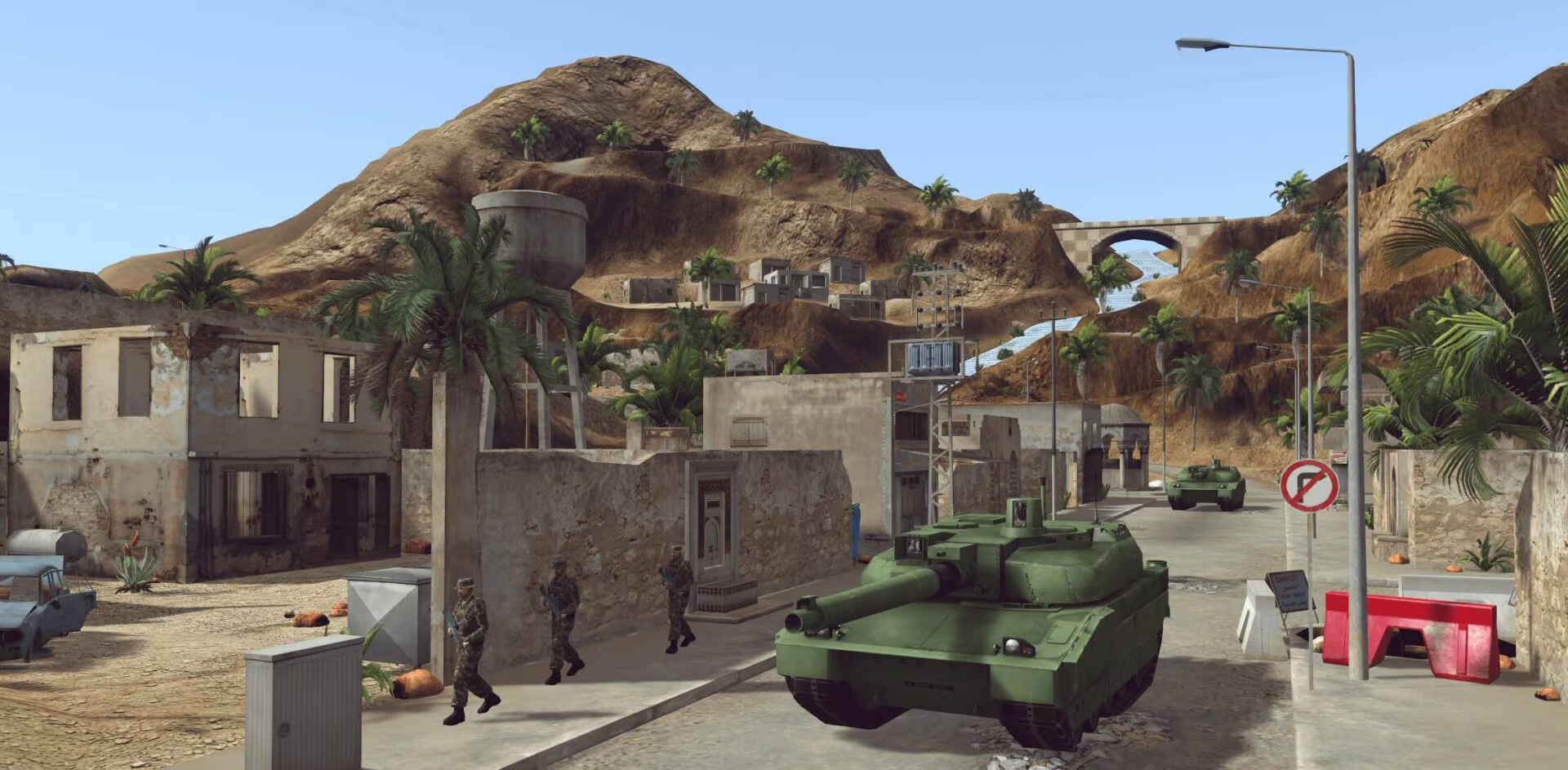
Using virtual reality (VR), a simulator can create a full, immersive digital environment in which choices can be made with observable (but safe) consequences.
- Rehearsal for specific (real) missions or military operations
A particular advantage of simulators, creating scenarios that mirror real-world operations, past, present, or future, ensures trainees are gaining the skills necessary for the exact kind of environment intended.
Simulation for combat readiness is more effective the more specific it can be made to the end goal.
- Practicing team-based training
Simulator installations are perfect for collective training.
Multiple stations can network either locally or over the internet, allowing allies across the globe to practice team-based tactics. This is key to practicing the 'soft' skills of confrontation, such as listening, cooperating, and supporting each other under pressure.
In a practical sense, defence simulation training involves the use of specialised hardware to gain the full advantage on offer.
VR headsets are incorporated to immerse the user in the virtual environment, with installations like VR CAVEs literally immersing them in the simulation.
The user then navigates the simulation according to its parameters and the learning goals of its design; control of the simulation may rely on a keyboard and mouse, or it could use special handheld controllers paired to a VR headset.
How has AI been integrated with modern military training simulations?
AI has allowed simulators to break past their previous limitations.
Instead of relying on scripted scenarios, thereby creating the unintended consequences of trainees learning the script rather than the situation, AI allows military training simulation to be responsive and adapative to the user.
This means simulated enemy forces that change their tactics in response to the user and challenge their decision-making, or even 'director' level AI that adapts the virtual environment as the exercise unfolds.
AI may also be less directly involved in the exercise, instead watching and analysing to reveal trends and training data that would have been impossible to glean in previous years.
To understand more about how Antycip and its partners have directly helped bring military simulation to the next level with AI, see our work for the MoD here.
How effective is military simulation?
Military simulation is at its most effective when it represents part of a whole training regime.
It shouldn't replace real-world training exercises, but it's an incredibly effective tool that cannot, and should not, be discounted.
Why? Research has shown that it is the psychological fidelity of training that is is key to effective learning, not necessarily the physical.
When military simulation training is used to build company-level readiness, physical training can focus on refining the skills that are already being built by simulation, rather than trying to teach them from scratch.
This approach makes sense when one considers how repeatable and accessible simulator training is, compared to real-world exercises.
Where next? The role for simulation in teaching future combat effectiveness
The advantages of military simulation are clear and irrefutable.
Investment in the technology speaks for itself, the US and Europe account for 65% of the global market for military simulation and training, a market forecast to be worth $23.45bn by 2034.
Instead of anything radically different to what is in use now, the future of simulation for combat effectiveness will instead likely lean into AI, digital twins, and synthetic battlefields.
AI is already changing how computer-generated forces behave and respond to users, as well as collating and analysing data in new ways.
Digital twins will develop in sophistication and detail, allowing soldiers to train with equipment and learn in environments that are closer than ever to the real thing.
Synthetic battlefields represent the logical progression of defence and military simulation training.
They combine AI, VR, and interconnected platforms and systems to create a large-scale, complex training scenario.
These can see pilots in flight simulators, tank crews in vehicle simulators, and ground infantry all practicing in the same virtual battlefield simultaneously.
How Antycip can help
Simulation for military training enhances war-fighting skills beyond traditional training, and it is far from its peak.
Those who will push the sector even farther are the experts who have the connections, technical knowhow, and ambition to create the simulation solutions of tomorrow.
ST Engineering Antycip (Antycip) is Europe's industry leader in simulation solutions for defence and military.
Our in-house knowledge, market connections, and vast network of trusted partners are second to none.
To find out how we can build your perfect installation, contact us today.