Past 60Hz: the quiet rise of high frame rate in Simulation and VR
Why a figure most people never thought to question has become one of the first things customers in our focused domains ask about
When people talk about a display, the first numbers they reach for are usually resolution and size. Frame rate tends to sit further down the list, taken as settled: 60Hz for a simulator, 24 frames a second at the cinema in general, both long treated as the point at which motion simply looks smooth, and there is nothing more to gain. For a long stretch, that assumption went unchallenged, and for ordinary viewing, such as predetermined video, it held up well enough. What has shifted is that customers with real-time CGI content now ask for more, directly and by name, and the reasons they give have little to do with appearance and everything to do with what the work demands.
We at Antycip have been delivering high-frame-rate systems into real environments rather than describing them from a distance, and the gap between those two things is rather the point of this piece. So, it is fair to set out plainly what changes once you climb past the old baseline, where the hardware genuinely stands today, and what becomes possible now that was out of reach only a few years ago. This is a technology explainer rather than a sales pitch; the most interesting parts of the story carry themselves.
Why the old numbers were never the ceiling
Both 60Hz and 24 frames per second describe what looks acceptable when you sit still and watch, not what the eye and brain can actually use once a scene begins to move quickly. That distinction is where the case for high frame rate begins, and it is a practical case rather than a matter of taste.
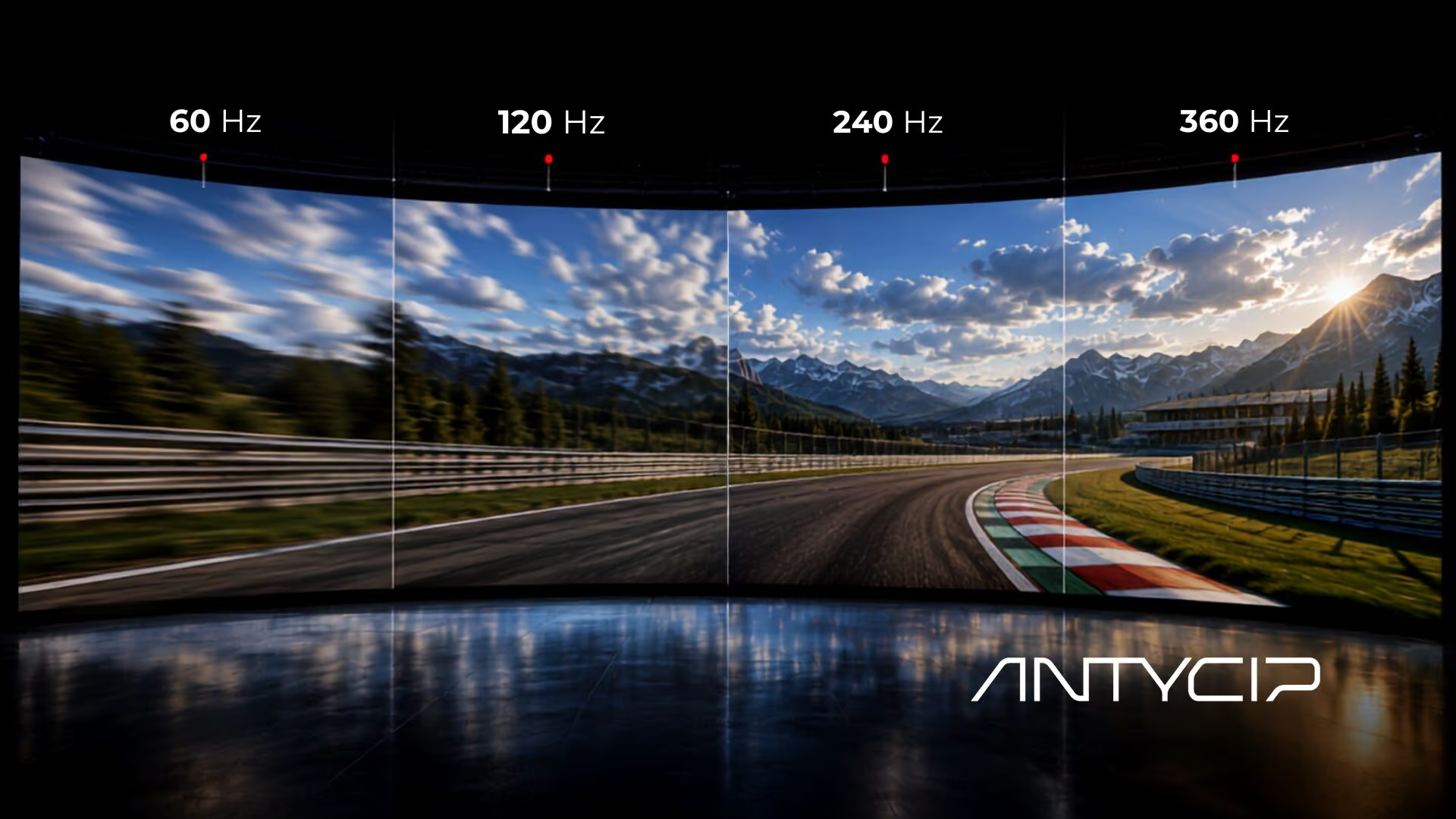
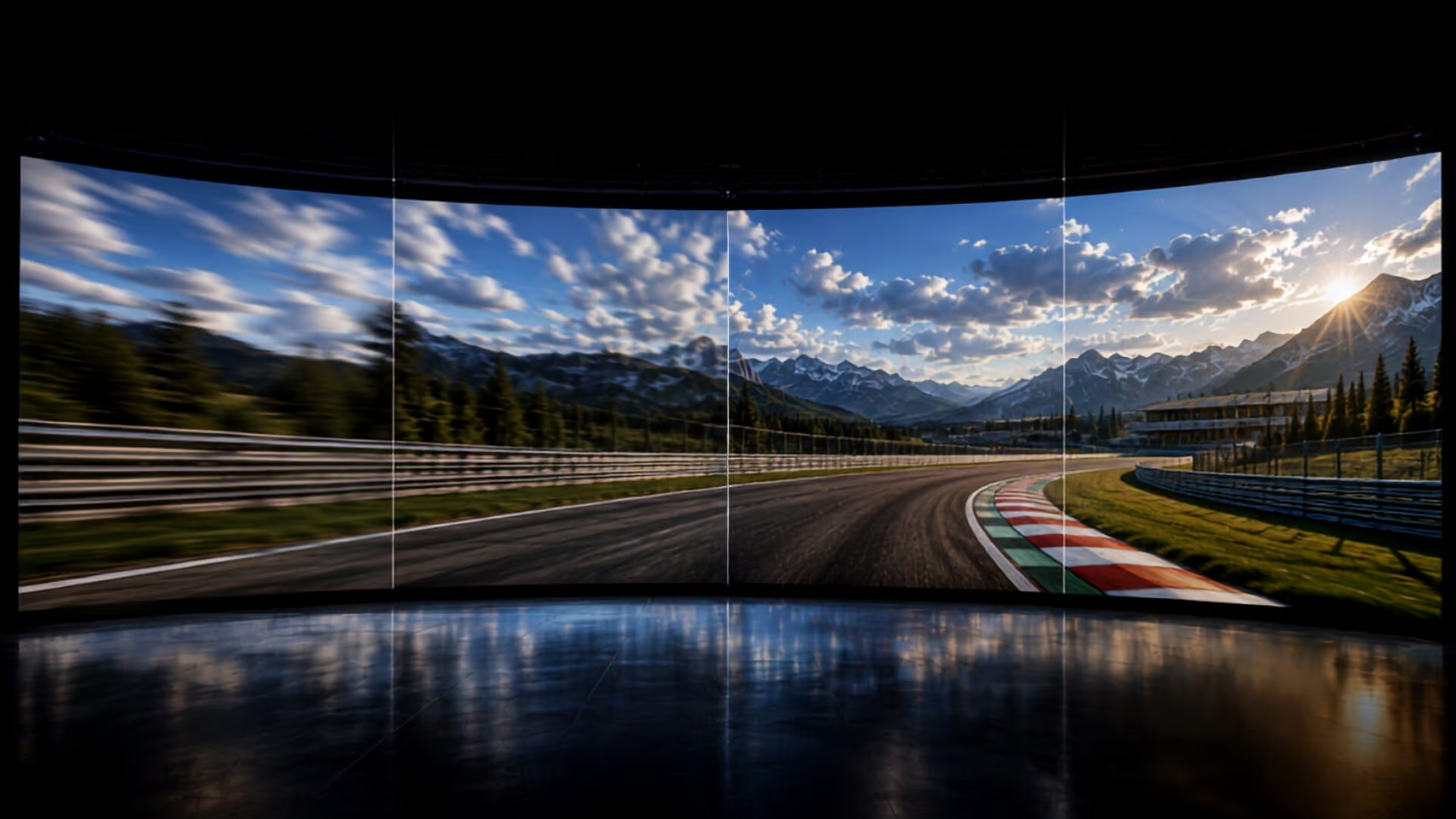
Lift the frame rate and motion blur falls away; the image holds its detail at the edges of your vision rather than smearing across them as the scene rushes past. That counts for most in the fast work, driver-in-the-loop studies, racing simulators, fast jet even, where the periphery is not decoration but a genuine source of information. A driver judges speed, closing distance and position from what is happening at the corners of the field of view, and a blurred corner is detail lost. Sharpen it, and the simulation tells the truth more faithfully. Bringing the visual latency down also helps to marry the visual with any motion platform and to reduce potential nausea.
There is another benefit, quieter but no less useful: less eye fatigue. In a training setting, that reads less as a comfort note than as a question of output. People can work for longer before they need to stop, and a longer productive session changes what a full day on the system is worth.
Where the technology actually sits
It is only honest to admit why this remains specialist territory. Pushing beyond 60fps is not something the majority of display manufacturers set out to do, because the mainstream professional AV market has less call for it. Multimedia video content is forgiving, and this level of signal handling involved sits well past anything that the world requires unless you delve into the realms of VX production studios, which again links us back to the world of CGI.
The pressure to go further has come from a different direction entirely. Computer-generated, real-time rendered imagery is what forced the pace, and it drew a small number of manufacturers out of the standard professional-display space to attempt something harder: electronics able to move very large pixel counts at high frame rates, carrying the bandwidth that combination demands and delivering low latency to the display. As 4K became the resolution customers wanted, some of the manufacturers we work with found ways to pixel-shift to 4K perceived pixels while still delivering the image at 120Hz, in either 2D or 3D.
From there, the picture is firmer. 240Hz stands as the current high-end standard, and we have sold and deployed it to customers running serious motion work on Barco hardware, among others. The industry is already reaching past that mark, testing into the 360 to 480Hz range. Digital Projection, for example, has allowed us to deliver this for specialised applications. None of this is a laboratory curiosity. It is the direction the technology is genuinely travelling, and we are working at the leading edge of it rather than waiting to read the results.
From one perspective to several
This is the part that covers ground a headset cannot reach, and the part that rewards a closer look. High frame rate is what makes multi-view stereo possible in the first place. Rather than drawing a single-tracked perspective, the display renders separate frames for several eye points at once, and the higher the frame rate climbs, the more people the same space can serve. At 240Hz, two people sharing one display each take in a fully corrected three-dimensional dynamically computed view at the same moment. At 360Hz, that becomes three; at 480Hz, four simultaneous viewpoints all upon the same display pixel real estate. Configured for collaboration rather than stereo depth, that same headroom can instead carry eight separate 60Hz images at the high end.
What sets this apart is that everyone stands together in the room, wearing lightweight eyewear rather than strapping an alien display to their face. They can read one another’s expressions, catch how a colleague or client reacts to a scene as it unfolds, watch someone lean in or step back. The collaboration is human as much as visual, and for the design review, training and research our customers carry out, that is a difference worth stating directly. We each move through the real world from our own point of view and never think twice about it; there is little reason a shared virtual environment should ask us to give that up. It is all about giving that real-world accepted capability for a fuller comprehension and immersion.
Resolution bought with speed
Speed buys more than smoothness. By oscillating the image very rapidly and combining the image generators' application frames offset in both time and space, a 240 Hz 4K display can present what the eye reads as an 8K picture without ever being natively 8K. The frame rate and content, in other words, are doing work that would otherwise fall to the panel itself, and the result is the detail the viewer perceives as real resolution.
VR sits at a slightly different angle to all this. Its scenes tend to move more gently, so the motion-blur argument carries less of the load, but the multi-view capability and the high perceived resolution make these displays well suited to collaborative design review, where the requirement is for several people to share a view of the same model, in the same room, at full fidelity.
Moving the data
None of the above counts for anything unless the imagery reaches the display uncompressed, and at these frame rates, that becomes a genuine engineering problem rather than a footnote. Today, graphics cards are becoming more powerful, as are the video cabling mediums, such as fibre optics, to deliver the video stream. Several of the partners we work with are pushing hard at this very challenge, looking for ways to simplify how video signal data is carried today, so that the volumes of high-frame-rate content generated can travel without being forced through compression and surrendering fidelity along the way. We are following that work closely, and it is the kind of progress that makes options such as direct-view LED begin to look like a realistic prospect for pipelines built this way.
The forward view
The thread running through all of it is the same one that runs through everything we do: this is not theory for us, but the work in front of us, being built and tested now. We had hoped to show it in person this year. With that off the table, we are planning a demonstration event for the first quarter of next year, a chance to stand in front of the difference rather than read about it.
If high frame rate is on your mind, whether for a simulator, a collaborative VR space, or a requirement that does not yet have a tidy answer, we would be glad to hear from you, and glad to keep you posted as the event takes shape. Get in touch through our contact page and we'll pick up the conversation from there.