Today’s geopolitical military picture is complex and everchanging.
This is apparent not only in the conflicts that ignite and cool with each passing year, but also in the global increase in military spending that continues to rise in 2026.
Not only did global defence expenditure total $2,887bn in 2025, but it marked the 11th of consecutive yearly rises.
Naturally, with rising spends comes the search for the means to reduce them – without also reducing their returns.
Military training simulators answer a crucial need to make fighting forces ready for the future, reducing costs yet preserving the importance of high-quality preparation.
What is meant by the term ‘military simulator’?
Military simulators encompass a range of solutions that incorporate hardware and software to create an integrated training environment.
They often mimic real-world environments while enhancing the user’s immersion with projection domes, motion systems, and virtual reality (VR) or augmented reality (AR).
Simulators can be completely digital, accessed through desktop PCs and operated using controllers.
They can also blend digital and physical, like those that see aircraft pilots using mock cockpits mounted on moving platforms.
A key feature of these simulators is that they don’t aim to simply look or feel like realistic combat scenarios; they recreate them with as much accuracy and immersion as possible.
How is a military simulator different from a traditional training exercise?
Often called field training exercises, or, less commonly, wargames, traditional training takes place in a real-world location with live attendance by trainees and other military personnel overseeing them.
This also means that real equipment needs to be made available and transported to the location along with any necessary vehicles.
Military simulation training instead uses technology to construct learning environments.
While some simulation solutions may incorporate physical elements to teach equipment operation, spatial navigation, and familiarity with vehicle cockpits, the training material is delivered to the user through an immersive display.
How military simulators work
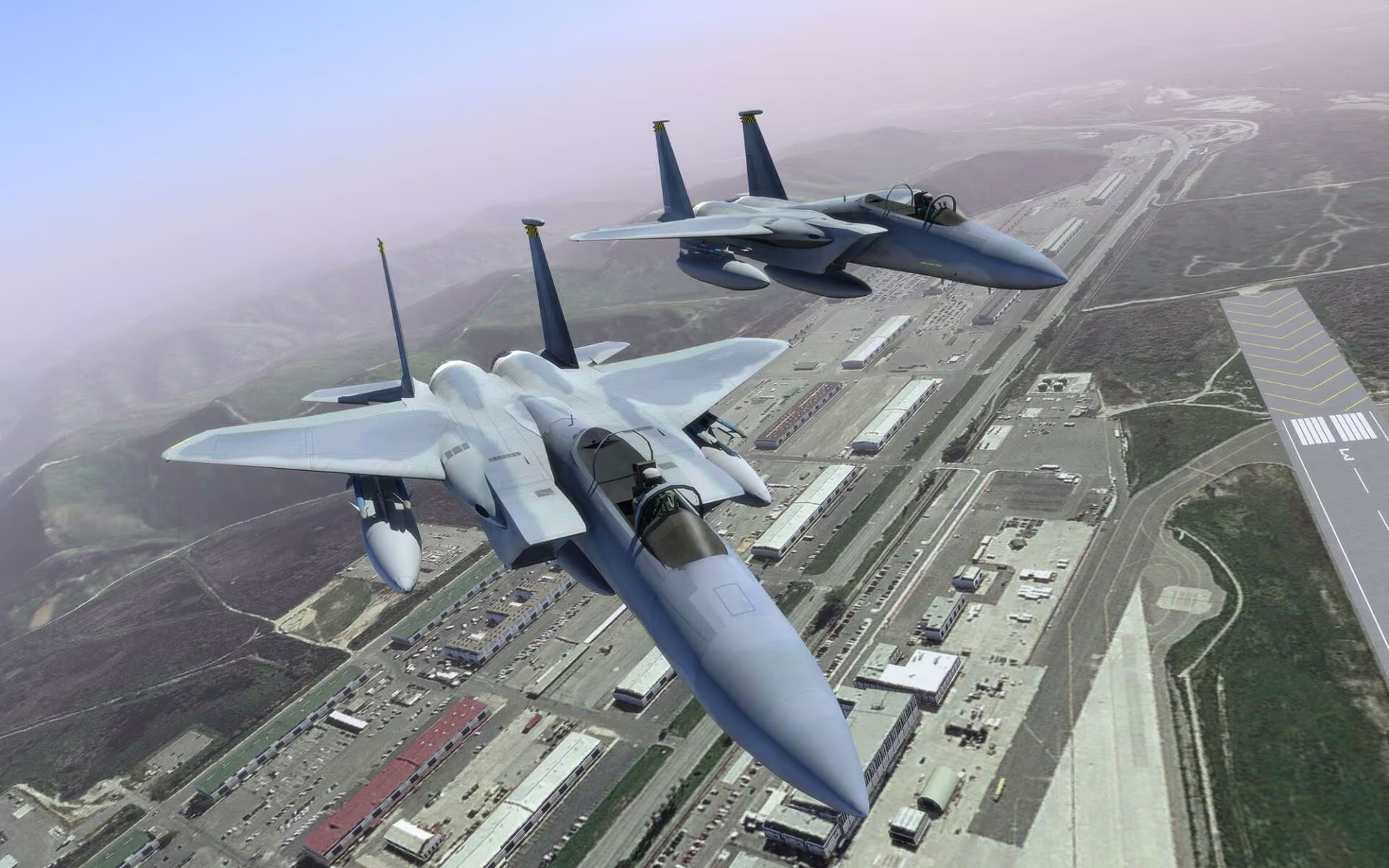
Military simulators use digital recreations of the environments most pertinent to trainees (See: types of military simulators below).
These digital terrains are accurately recreated through use of existing data in the form of satellite images, digital elevation models, and mapping databases.
With the virtual environment (the world) in place, the simulation itself (the engine) dictates how things happen inside that world and the factors in play.
For defence simulation, this means running many complex, smaller-scale simulations concurrently, including:
- Physics, including ballistics and the travel paths of projectiles
- Weather effects, how they affect user visibility, and how certain weather like high winds might influence ballistics or other behaviours in the world
- Vehicle movements and behaviours, how weight affects their speed and stability, and how their movements affect the world (such as kicking up dust, further interacting with weather)
- Damage and how it is modelled on vehicles, terrain, or buildings; vehicles may become inoperable if too damaged, or a user could be ‘incapacitated’ if caught in crossfire
Software developments in military simulation have eliminated the need for multiple engines in a virtual environment.
MAK Technologies’ VR-Forces platform, for instance, enables the above simulations in one application.
Finally are the users themselves, accessing the virtual environment and interacting within the software to navigate the world and learn from their experiences.
Key technologies used to interact with military simulators include virtual reality (VR), augmented reality (AR), and – now more than ever – artificial intelligence (AI).
Virtual reality (VR)
When using VR, the user’s view of the real world is replaced with a virtual one.
This is done through two key means: VR headsets and cave automatic virtual environments (CAVEs).
Headsets contain small screens, lenses, and eye-tracking sensors. By turning their head, the user’s view will pan across the virtual environment accordingly, and the lenses provide a sense of depth.
Handheld controllers enable movement and other actions in the virtual world.
CAVEs are environments wherein the projected images surround the user on the floor and walls. Eye movements are tracked via special glasses.
Augmented reality (AR)
Where VR ‘replaces’ the user’s environment, AR preserves their view of the real world while projecting digital images that enhance it in some way.
In the context of a defence simulator, this might include navigation data, target information, or positions of allies.
AR glasses and headsets are used to achieve this blended reality perspective.
Artificial intelligence (AI)
Recent strides in AI have brought a great deal of benefits to military simulation training systems.
Previously, the predetermined behaviours of computer-controlled entities – like enemy forces and vehicles – could be learnt once a script or pattern began to show itself.
AI brings adaptive tactics and the ability to dynamically change strategies as scenarios unfold.
AI systems can also monitor user performance and collate data for detailed feedback.
Common types of military simulators
Military simulators exist for every area of the defence sector and the roles they contain, including:
| Type of simulator | What it does |
|---|---|
| Flight |
Teaches pilots how to operate aircraft from the cockpit.
Often, these use motion platforms which physically move the user’s seat according to their actions in the simulation, mimicking the motion experienced by pilots.
|
| Vehicle |
Tanks, personnel carriers, and logistics vehicles can be simulated to build knowledge of their speeds, control systems, and weapons systems.
The user’s perspective within the virtual environment can also build awareness of blind spots and how to locate certain systems in the vehicles’ driver seats.
|
| Maritime |
Maritime training has a unique set of demands and requirements to bring personnel up to speed.
Ships rely heavily on navigation and communication systems to avoid collisions and chart courses.
The same goes for submarines, which also rely on sonar, periscopes, and weapons systems suited to deep water.
|
| Infantry |
Defence simulations can teach infantry essential war-fighting skills unrelated to operating vehicles or other craft.
Moving in formations, communication protocols, and preparing for engagements are among the many skills a soldier needs to be prepared and be able to be responsive in the field.
|
How military simulators are benefitting from AI-driven training solutions
As mentioned earlier, the key benefit AI brings to training solutions is increased realism.
The learning capabilities of AI models, which can be used to shape scenarios on the fly and respond specifically to the user, means that those users are significantly closer to the real thing.
AI helps ensure that users are learning less how to navigate the specific training scenario with its predetermined rules and triggers, and more how to respond to a real-world situation that could occur in any number of ways.
Case study
To see how military training simulation technology translates into a full, interoperable solution, see Antycip technology with MyIG and VR-Forces integration.
What are the benefits of using simulation in military training?
The benefits of military training simulation are best conveyed in several ways.
- Enables mission rehearsal and improves tactical decision-making
The main goal of military training is to prepare soldiers, pilots, and other personnel for situations they are likely to encounter in their careers. The more familiar a situation is for the individual, the less likely they are to be overcome by indecision and panic. This is the basis of recognition-primed decision making, something that allows professionals to make high-level decisions without being bogged down with multiple possible choices.
- Capacity to repeat exercises to hone skills
The repeatability of simulated missions simply cannot be copied to real-world exercises. While time is a finite resource whatever the method of training, simulations don’t demand the logistical feats of large-scale training in a physical environment. Once a mission has concluded, feedback and lessons learnt can be reviewed and shared, and the mission reset and run in a matter of moments.
- Helps support joint operations or large-scale exercises
Joint ops and large-scale training exercises can be highly challenging to coordinate and execute. A single simulation platform, or multiple platforms interfacing with each other, still enables allies to practice coordination and joint efforts without the logistical demands of meeting in friendly territory.
- Cost efficiency
Once a simulation installation is in place, the only associated costs lie in the power to run it and routine maintenance. Even a mistake that would constitute an expensive disaster in the real world is only a reset away from being undone. For cost efficiency, defence simulation is unparalleled.
Limitations of simulators compared with real-world training environments
Of course, no solution is ever wholly perfect.
One shortcoming is that simulation can train a user for the appearance, context, and decisions associated with a scenario, but not necessarily the physical demands.
Trainees on a simulator can’t truly know how tiring or stressful a situation is until it’s been experienced in the flesh.
In this sense, there are some things that simply can’t be trained or taught on a simulator, equipment weight, sensory overwhelm, and G-force to name a few.
This is why simulators are often, and best, seen as a supplement to real world training rather than a wholesale replacement.
Antycip’s expertise
ST Engineering Antycip (Antycip) has a long road of tried, tested, and proven experience in military simulation training.
We are Europe’s leading provider of VR, visual displays, and simulation solutions, working with a vast network of trusted partners who bring the cutting edge of their own markets.
For a bespoke solution tailored to your exact needs, look no further.
Contact us today to discuss the next level of your training.