And Antycip still leads the way!
How the immersive room has changed over a quarter of a century
When people picture virtual reality today, they usually picture a headset. It is the image that fills product launches and tradeshow stands, and for plenty of uses it earns the attention. Yet alongside the headset, another approach to immersion has been evolving for a very long time: the room you step into, rather than the display you wear. The CAVE.
We at Antycip have been designing and building these rooms for more than 25 years. To us, that span is more than a milestone to mark. When our earliest systems were already up and running, a good many of the companies now talking about immersive technology had yet to start trading. We think that it is worth stating plainly rather than tucking away, because the years behind us shape almost everything about how we work today.
So, what has changed across a quarter of a century of the CAVE? Where does the technology stand now against where it began, and where is it likely to head next? This is our look back and forward.
What we mean by a CAVE
A CAVE, short for Cave Automatic Virtual Environment, is a custom-designed room space whose walls and often its floor and ceiling present a continuous visual image around the occupants. Tracking follows the user’s 3D Glasses position, so the scene updates to their viewpoint, and stereoscopic separation gives these images depth. The result is somewhere you walk into and move through on your own two feet, with none of the isolation or prolonged-wear fatigue a headset can bring, and with your hands, colleagues and surroundings still in plain sight. It suits work where context, scale and a real sense of presence all matter: engineering design review, vehicle and pedestrian research, training that must transfer to the real world, and collaborative sessions where a group needs to share what they are seeing.
Why 25 years counts
Time served on its own proves very little. What those years have given us is the comprehension at a 1:1 scale or beyond and the means to solve problems that do not come with an off-the-shelf answer.
Long experience with software, set alongside the practical know-how built up job after job, is what lets us act as a solutions provider rather than a supplier of fixed kit. We are not handing a customer a catalogue and asking them to pick the nearest fit. Our strength in design and in tailoring each build to the task in front of us means we can move past standard specifications and meet a requirement; however unusual it turns out to be. When a brief sits outside the ordinary, that is usually where we do our most satisfying work, and the two projects below show exactly what we mean.
Two rooms, two very different problems
A pair of installations that we at Antycip have completed make the point better than any claim could.
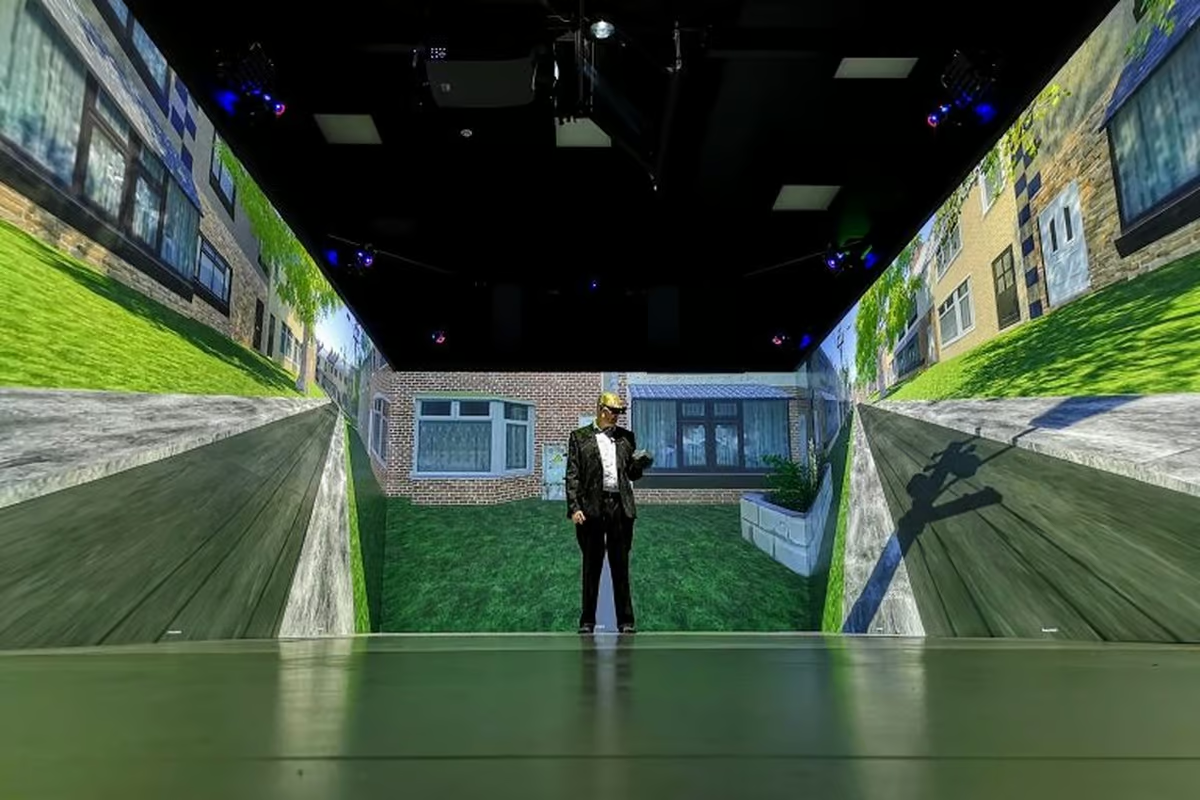
The first is the HIKER lab at the University of Leeds, a glass-based design with distinctive engineering behind it. It was created to research how pedestrians read and react to automated vehicles, and it gives participants a 9 x 4 metre walking area at a high resolution, enough volume to move on foot naturally, in a way no tethered head-mounted display can easily manage. Meeting that remit asked a great deal of the team. Each of the two nine-meter side faces had to be formed from a single-piece of a specialist glass substrate to offer a geometrically accurate screen surface, finished with a specialist optical coating for clean blending, strong contrast and wide angles of view, then maneuvered into premises that left next to no margin for error. Barco laser projectors on ultra-short-throw optics carry the imagery, switching between pixel-shifted 4K and 3D stereoscopic modes as each study calls for.
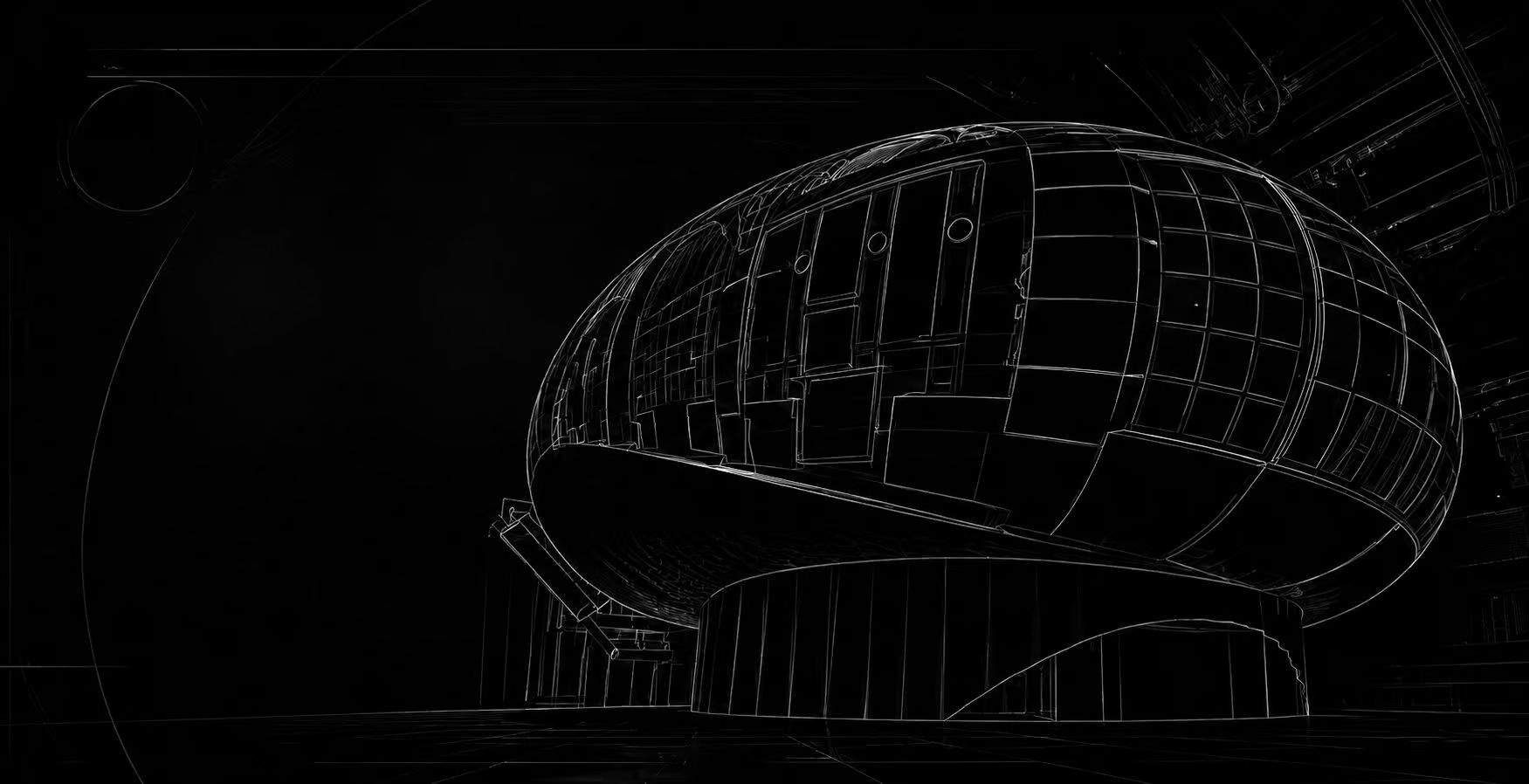
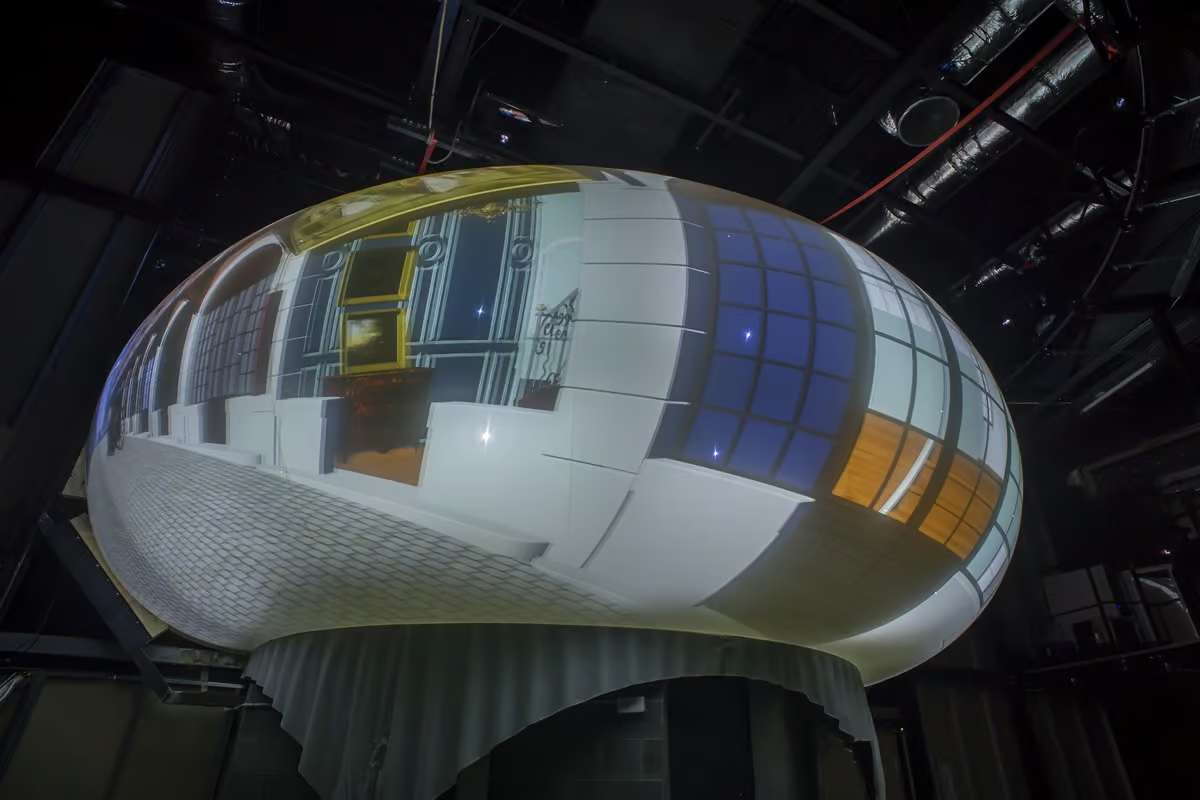
The second is TORE at the University of Lille, a fully curved space that Antycip built to the University’s brief. Leeds called for length; Lille, for curves: a flattened, torus-shaped surface more than eight metres across that holds a steady distance from the viewer through a full 180 degrees, with no break in the picture. That geometry extends well beyond the cylinder most displays of this kind settle for. Twenty Barco I600 units and an automatically calibrated digital correction system now drive it, supporting higher refresh rates, heavier scenes, the integration of artificial intelligence and early work on linking separate environments for remote collaboration.
The common thread is simple. We start from what the customer actually needs, not from whatever happens to be easiest to put together, and these two projects are only a small sample of what we have completed; we have even mounted a CAVE on a motion platform, which gives some sense of how varied the people who come to us can be. A pedestrian researcher, a university arts and science centre, and a client who wants the very floor to move beneath them are three different conversations, and each one starts from a blank sheet.
From one viewer to several
The hardware behind the name has changed a great deal, and the clearest shift is in how many people a CAVE can serve at once.
A traditional setup was a single-person affair. The visuals were drawn around one dynamically tracked perspective and the corresponding three-dimensional view, which left everyone else present looking at the picture trying to follow that eyepoint so that the imagery presented looked correct. That is no longer the ceiling. Today, we run multi-view stereo at 240Hz, so two people sharing the same CAVE can each take in a completely different virtual perspective at the same moment. We have pushed the idea further again, reaching 360Hz on a VR Powerwall for three perspectives, and four simultaneous views at 480Hz are now possible with current emerging hardware.
This is something a headset still cannot offer, because the group occupies one physical space, you can read human expression and body language, catch how a colleague or client is reacting and responding to the content as it happens, and watch someone lean in or step back as a scene plays out in front of them. The collaboration is human, not only visual, and for the design review, training and research our clients carry out, that difference is worth saying directly. In reality, we can each view the world from our own chosen perspective and take this for granted to aid our comprehension, so why not inside a virtual environment?
From projection to direct-view LED
The second change is in the display surface itself.
Projection has been the default for CAVE displays since the very beginning, and it still does the job well. But direct-view LED has moved from a prospect we talked about to an option we have delivered. Its higher brightness counts for a great deal in stereo 3D, where a portion of the light is always given up to the separation process that splits the image between the left and right eyes: start brighter, and you finish brighter too. Direct-view LED CAVE’s can offer a more compact footprint compared to traditional rear projected CAVE’s and have zero shadowing compared to front projected CAVE’s making them perfect for some customer environments where a traditional configuration may not be physically possible to deploy. We treat LED as the next step along the same road rather than a break from what came before, and we expect it to feature in more of the rooms we build as the technology moves forward.
The long view
Twenty-five years means that we at Antycip have seen every version of this technology and stayed current through all of it: the projector generations, the leaps in resolution, the move from a single occupant to several, and now the arrival of LED. Headsets will keep their share of the headlines, and fairly so for many tasks, and they will also complement many VR CAVE’s by networking with them collaboratively. Yet when the work calls for a shared, walk-in environment that several people can read together at full fidelity, the CAVE has quietly become more capable, and we have been alongside it for the whole of that history.
If any of this is on your mind, whether a CAVE, a wider immersive room, or something unique that nobody has asked us for yet, we would be glad to hear from you.